
Written by Courtney Human RD(SA)
Let’s face it – this rather crappy topic was bound to come up. As a registered dietitian, I talk about bowel habits quite comfortably daily. I don’t get it. We all do it, we all pretend we don’t, and we’ve all invented bizarre metaphors to avoid saying it out loud. “Dropping the kids off” , “launching a torpedo” , or my personal favourite: “offloading emotional baggage.” It’s time to stop dancing around the bowl and dive into the one topic that no one wants to talk about, but everyone needs to understand. Welcome to the crappiest blog post you’ll ever be glad you’ve read. Your poop is your body’s daily report card – so buckle up, bring your best toilet humour, and let’s cut the crap. Literally.
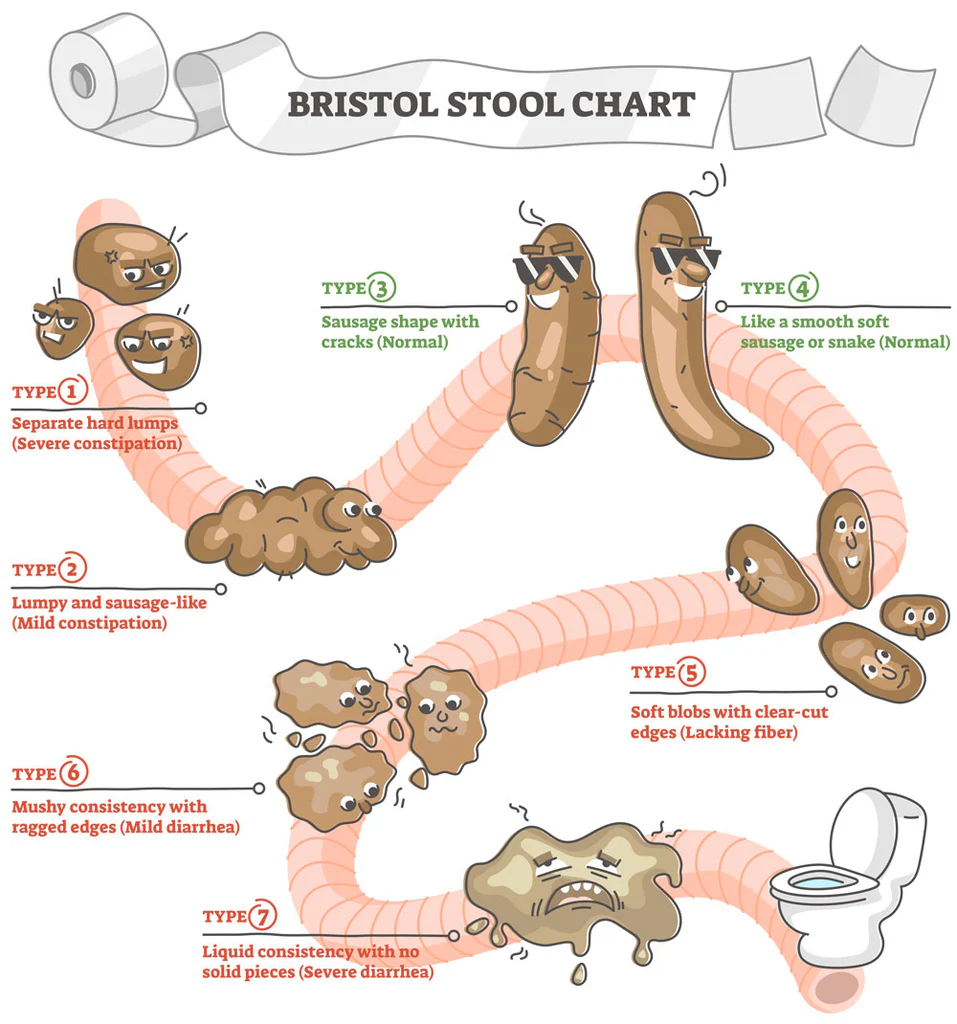
Behold the ‘Bristol Stool Chart’, it’s like the Rosetta Stone for your gut, categorising your output into 7 distinct types to determine what’s normal and what’s not. Knowing where your daily deposit lands on this chart is the first step to understanding your digestive health. I promise this royal flush of knowledge will be worth the cringiness.
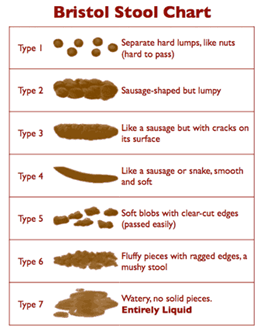
To decode this chart, we will start from the top with type 1 which is classic severe constipation. A bokdrol situation is not ideal for human beings. This is painful. There is a slight improvement with type 2 but this is still considered constipation. Imagine passing a bunch of nuts glued together. This is often a tearjerker – not in a good way. Moving onto type 3 we are sitting at a B report card. This is considered normal, but still a bit on the firm side, not an outstanding achievement. Now if you are lucky enough to have a type 4, you are a dietitians A+ student. This is the Beyoncé of bowel movements. Easy to pass with no strain. Type 5 is more of a C student, also good but leaning towards slightly too soft. Finally, with type 6 you are getting into diarrhoea territory and with type 7 you are in full-blown diarrhoea. No Karen, this is not what dreams are made of if you suffer with constipation 99% of the time. So, ideally, we’re aiming for Types 3 and 4 with the more smooth, easy-to-pass varieties.
I often get asked, “But what is normal?” or “How often should I be going?”. According to the latest scientific evidence, ‘normal’ bowel frequency can vary from person to person. It ranges anywhere from three times a day to three times a week. BUT,in terms of texture: if you are straining, having pain, or feeling incomplete after a bowel movement, these are all red flags. Regardless of frequency, if you are passing a bok drollie every hour or having diarrhoea every 3 days that’s still not ‘normal.’
Overall, in practice, I see the constipation conundrum dominating the world of bowel habits. Typically, it boils down to what I call the “Three Cs” and at least one of them always seems to be the missing link.
- Consistent Meals (or lack thereof): Our guts are creatures of habit and regular meals stimulate the gastrocolic reflex. Skipping meals, especially breakfast, can slow down gut motility.
- Consistent Fibre: We need both soluble and insoluble fibre. Soluble fibre dissolves in water to form a gel-like substance, helping to soften stools. Insoluble fibre, or “roughage,” adds bulk to your stool, helping it move through the digestive system more quickly. Often, it’s about the right balance!
- Consistent Water Intake: This is essential as fibre needs water to do its job. A good rule of thumb is roughly 1 cup of water for every 10kg of body weight per day, in addition to other fluids.
Often there is a misconception that when someone is constipated and then has diarrhoea that it’s the body clearing itself. Not quite. Chronic constipation can lead to something called “overflow diarrhoea.” Imagine a traffic jam in your colon. The impacted stool acts as a blockage. Liquid stool from higher up in the digestive tract then has to find a way around this, resulting in watery, loose stools that ‘overflow’ past the hardened faeces. It’s a sign your system is struggling and not finding a solution on its own.
When things aren’t moving, it’s tempting to reach for laxatives – but be careful. Stimulant laxatives can lead to lazy bowels and long-term dependency. A better option? Stool softeners like Movicol, Duphalac, or Lacson, which draw water into the colon and ease things along more gently. But even before that, start with fibre. Psyllium husk, chia seeds, oat bran, and Fybogel (my personal fave) help create soft, bulky stools naturally. Once again, fibre supplements are pointless without adequate water intake. I always suggest taking them at night or starting slowly to avoid any rather awkward flatulence at work while your body adapts, which is a normal process if you are living a fibre free lifestyle beforehand.
In addition to the above, believe it or not, how you sit on the toilet matters! Squatting straightens your plumbing for an easier go, so try a footstool and thank me later. Ladies don’t rush or ignore the urge; holding it in can confuse your body, causing constipation and discomfort. Your body doesn’t forget but it just gets annoyed. Give yourself time, relax, and let nature do its thing. Reading or scrolling helps. This is something guys have definitely mastered (sometimes a bit too well, if you ask me). We see you enjoying that secret escape!
Being aware of your stool output is a simple yet powerful way to monitor your health. If something seems consistently off (Type 1, 2, 6, or 7 for extended periods), or if you notice blood, severe pain, or unexplained changes – consult a healthcare professional. Don’t be shy as we’ve seen it all and there has never been a better excuse to talk crap for the good of your health and wellbeing.
Well, you’ve made it through the full scoop on poop and who knew your daily dump could spill the tea on your digestive drama? So next time you’re seated on the porcelain throne, give a nod to the Bristol Stool Chart and ask yourself, “Am I channelling Beyoncé or reincarnating into a Blesbok?” Remember, your stools are the unsung hero of gut gossip that tells all, never lies, and always leaves a mark.
So, keep your meals, fibre, and fluids consistent, and you’ll be well on your way to earning that A+ report card… one smooth delivery at a time.
0 Comments