
Written by Courtney Human RD(SA)
Let me paint the picture. My best friend and I had just finished a gym session when I realised I needed to grab a few things from Pick n Pay. While stretching she casually said, “I think I’m really lus for a doughnut.” Dangerous words. A few minutes later, she was standing at the bakery counter -and before I could even pretend to be sensible, she bought me one too. Not just any doughnut. The proper fried kind. Soft and juicy with just enough oil to make it melt slightly when you bite into it, topped with that glossy icing that sticks to your fingers in the best way. I took a bite and immediately thought, Wow. I honestly can’t remember the last time I enjoyed something like this.

And then… the familiar flicker of guilt started warming up. Did you really need that? You could’ve just had protein. You trained hard. Maybe skip dinner later. Except this time, I caught it. Instead of letting the guilt spiral take over, I paused and corrected the narrative. I’d eaten balanced meals that day. I wasn’t starving or eating emotionally. I was enjoying a doughnut with my best friend – and it was absolutely worth it. I didn’t skip dinner later (even though the temptation crossed my mind). I nourished my body like normal and moved on with my day without the guilt hangover.
And that small moment is exactly what a healthier relationship with food looks like – at least to me.
With Valentine’s around the corner, a holiday loaded with chocolate and indulgence, it feels like the perfect time to reflect on how we actually treat food and our bodies. If food were a relationship, many of us would have to admit it’s complicated. We ghost meals, overanalyse every bite, label foods as good or bad, and swing between restriction and overindulgence. If this were a romantic relationship, your friends would probably be staging an intervention. I think a genuinely healthy relationship with food should feel calm and predictable rather than chaotic. It means eating regularly without fear, trusting hunger and fullness most of the time, enjoying food without guilt, and making choices that support energy, digestion, mood and long-term health – not just the number on the scale.
Health is not about how little you eat; it’s about how well you’re nourished. Yet January often pushes us in the opposite direction. Diet culture thrives on the idea that December needs punishment. Detoxes, cleanses, cutting carbs and burning off calories dominate social media. Add perfectly curated influencer content and suddenly our eating choices become driven by comparison rather than connection to our own bodies. Never mind getting caught up in the skinner left right and centre about Maria on Mounjaro nearly falling through her …. stay in your nutritional lane judgy Jennifer, focus on your own journey. Low key you’re probably just jealous you can’t afford it. Jokes aside, many of us also grew up fearing the scale, demonising certain foods, being told to finish everything on our plates, or attaching moral value to eating. Those messages don’t magically disappear in adulthood – they quietly shape how safe food feels, how much permission we give ourselves to eat, and how quickly guilt shows up.
Sugar cravings, especially around holidays like Valentine’s, are commonly blamed on lack of willpower, but don’t be so hard on yourself as physiology tells a different story. Cravings are frequently driven by under-fuelling, skipped meals, low fibre intake, inadequate protein, dehydration, poor sleep, stress and mental restriction. Research consistently shows that rigid dieting and food restriction increase the likelihood of overeating later. When something becomes forbidden, the brain naturally wants it more. Scarcity creates obsession. This is why letting the novelty wear off is so powerful. When chocolate is allowed regularly and enjoyed mindfully, it stops feeling like a once-off event that needs to be maximised. You shouldn’t need a break from your “diet” if your eating pattern is truly sustainable.
Mindful eating simply means paying attention without judgement. It’s noticing hunger, fullness, satisfaction, energy, digestion and how certain foods make you feel physically and mentally. When eating becomes externally controlled we slowly lose trust in our internal signals. Rebuilding that trust has been shown to improve eating regulation, reduce binge–restrict cycles and support long-term wellbeing. In addition to this, nutrition science is also steadily moving away from weight-centric thinking toward functional health. We now understand the profound role of the gut microbiome, blood sugar stability, inflammation regulation and brain health in overall wellbeing. Fibre feeds beneficial gut bacteria and supports appetite regulation. Protein improves satiety and muscle health. Hydration supports digestion and cognition. Plant diversity improves micronutrient intake. When the body is consistently nourished and cravings stabilise then food becomes far less emotionally charged. Weight becomes a by-product of behaviour rather than the primary target.
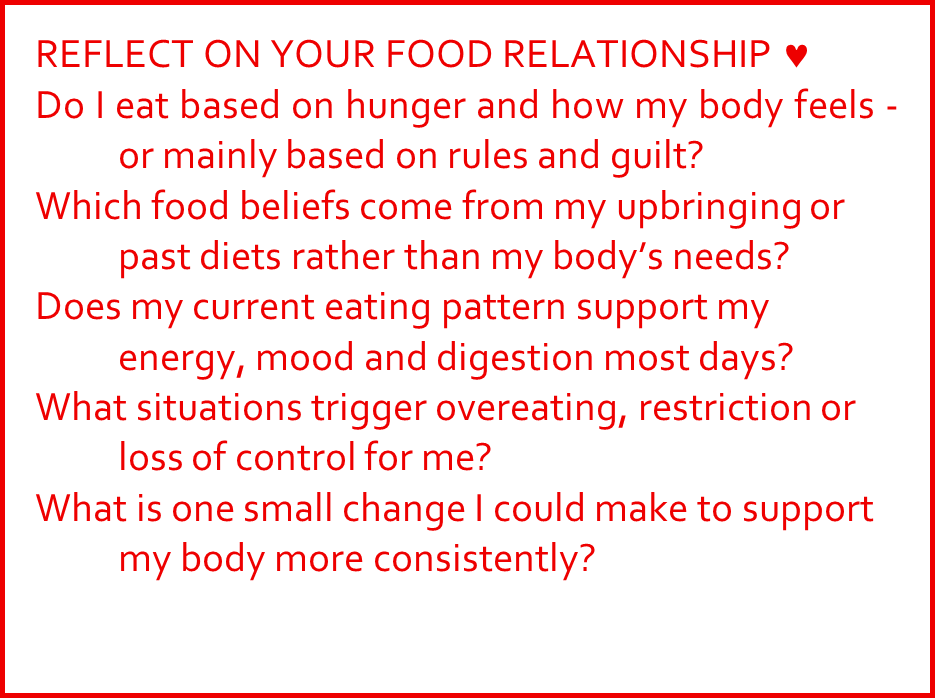
One of the most damaging concepts still lingering in diet culture is the idea of cheat days. Cheat days reinforce that normal eating is punishment and enjoyment must be earned. Food freedom, in contrast, doesn’t imply eating chocolate all day. It means a more flexible structure with balanced meals most of the time and pleasure included intentionally. You are allowed to enjoy your food and care about your health at the same time. Building a healthier relationship with food also means learning your own triggers without shame. For example, if I notice that one glass of wine often leads to wanting to finish the whole bottle, that doesn’t mean I’m broken or lacking discipline. It simply tells me I need supportive boundaries – perhaps choosing alcohol-free options during the week, slowing down with water between glasses, or deciding in advance what feels aligned with my goals. Awareness always beats self-criticism.
This Valentine’s, instead of another short-lived diet fling, consider building a relationship with food that actually lasts – grounded in science and self-trust. And yes, sometimes that relationship includes a really good doughnut after gym with your best friend. Honestly, that sounds like a pretty healthy love story to me.
0 Comments